
FILAPEDIA: HIP-HOP
Welcome back to FILAPEDIA, the encyclopaedia of FILA words.
The etymology of hip-hop is uncertain. What is certain is that it identifies the movement that emerged in the late 1970s in the United States among young people in African-American and Puerto Rican communities who advocated non-violence and art forms such as graffiti and rap music. More generally, it is used to identify an extremely popular musical genre based on fast rhythms, rhymes and sometimes crude language. Critic Jeff Chang hypothesises that the term first appeared in 1982, in a report in the Village Voice by Stephen Hager. In the article, New York, rapper Afrika Bambaata said that the Harlem -born phenomenon that was called ‘hip-hop’and that it had four elements – mixing records, rapping, breaking and painting graffiti. In a later article, Bambaata mentioned a fifth element: Knowledge.
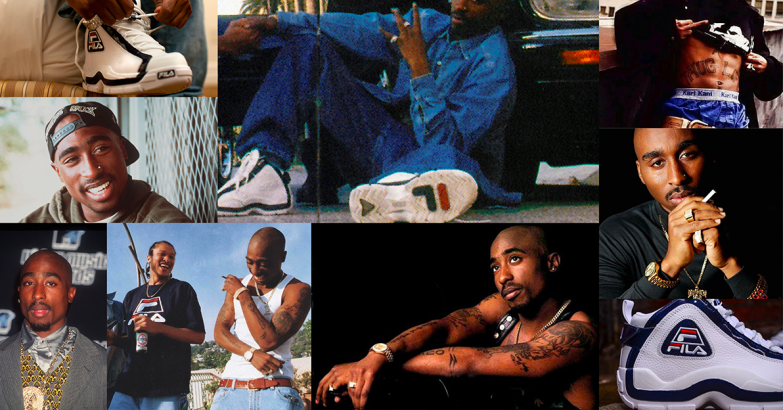
From the 1990s onwards, the word ‘hip-hop’ also began to appear in the FILA glossary. More precisely, when the Biella-based brand became a streetstyle reference, with clothing, accessories and footwear that jumped from the playing field to become part of everyday fashion. Successful musicians and rappers were partly to thank for this crossover. Back in 1985, Schoolly D released Put Your FILAS On. A feature of his debut EP of the same name, it is a youthful anthem that encourages listeners to embrace a style that is highly personal. A year later, the F-Box logo appeared on the cover of Oh My God!, the first album by Doug E. Fresh and the Get Fresh Crew. Fresh, born in Barbados, made a name for himself with his new and inventive rhymes. Among other things, he is known as the ‘inventor’ of beatboxing, or the ability to reproduce the sound of a musical beat with vocal cords.
The brand appealed to the black community and beyond. Over the years, the Beastie Boys – originally from New York, and one of the very few all-white crews to earn the respect of the hip-hop scene – wore FILA clothing, shaping an unmistakable style and a career that saw them sell twenty million records. And speaking of big names, let’s not forget Notorious B.I.G. – the Brooklyn rapper who tragically passed away in 1997 at the age of 24. FILA paid him homage in 2020 with a capsule collection that included, among other things, a T-shirt, a cap and a pair of trainers. Created in collaboration with the Christopher Wallace Estate (the artist’s birth name), the project celebrates the talent and legacy of ‘Biggie’ and the moment when, in 1993, at the age of 20, he took to the stage in Philadelphia wearing a T-shirt with a large ‘F’ emblazoned on the front.
Notorious B.I.G.’s death was only a few months after that of Tupac Shakur, the musician par excellence in FILA’s history (whom we discuss in depth here). The brand’s story is essentially a dense playlist, with a backbeat of hip-hop rhythms marking the evolution of culture and society.
Code Money!
I say Code MONEY!
Put your Filas on
Put your Filas on
Schoolly D, Put Your Filas On, 1985
“Today, hip-hop is intelligent, it’s profound. Its ability to communicate a complex message in a short amount of time is impressive.” Barack Obama, 2008